While Versailles Palace draws millions of visitors each year, few explore the town’s historic center and its rich cultural heritage. The city is ramping up efforts to promote these overlooked gems, and encourage tourists to venture beyond the grandeur of the palace.
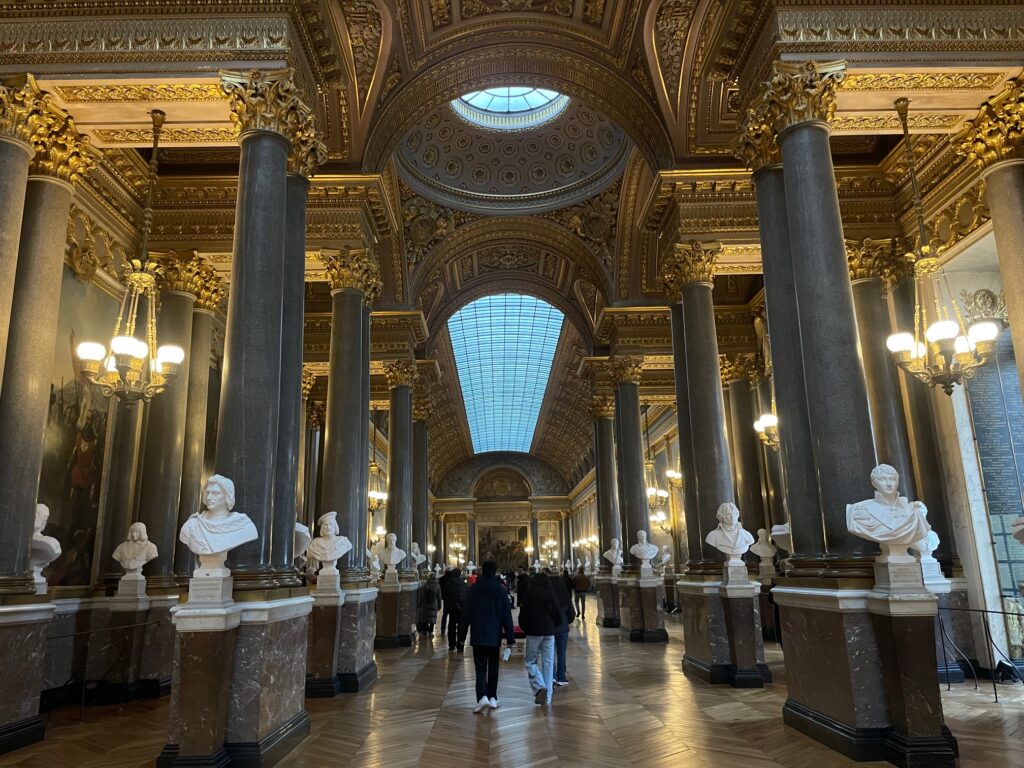
« What a dream come true! » Wrapped in large scarves, chilled but happy, a Canadian couple takes photos right in front of the Versailles Palace. A crowd of over two hundred people buzzes around, tickets in hand, waiting to get inside. As it’s the case every day. And who could blame them? “This, Madame, is Versailles,” they might say – or post on TikTok – a true jewel of history. For this reason, the former royal residence is the second most visited monument in France, after the Louvre.
“My father always told me I had to visit the palace, even before the Eiffel Tower or Montmartre. It’s a must-see,” shares Lucy, an exchange student from Utah. And Versailles is happy about that. However, while the palace welcomes over seven million visitors each year, many of these tourists overlook the surrounding town. “The only time I’ve ever been to Versailles was when I got lost trying to find the RER station,” jokes Montana, Lucy’s friend from South Carolina. “Are there even any other monuments to visit here? If so, yes, why don’t we go grab a coffee? We don’t know the city at all,” enthuse Amina and Alice, two friends coming from Austria.
The cobbled streets of Versailles are, in fact, filled with small shops of all kinds. Chocolate shops, bookshops, restaurants, bakeries – everything is designed to attract visitors. “Actually, Versailles is a very small town. The bakeries or pizzerias are mostly local businesses that cater to locals and regulars, not so much to tourists. On this street, for example, there are lots of hairdressers,” explains Florian, who was taking a cigarette break from his job at the Alban Kuntz bakery. Ironically, he is wearing a Mona Lisa shirt. “Listen, you’ll notice that nearly everyone crossing the street is French or lives here. It feels like a small neighborhood. Sometimes, it’s even like a ghost town, to be honest« , even for one of the best pastry shops in the Paris region.
“The location of the historic center is poorly marked”
A few streets away, in the historic center near the Palace, she’s there standing majestically, rococo-style, reaching to the sky: the Saint Louis Cathedral, erected in 1742. She has been listed as a historic monument since 1906. A gem of heritage, yet little known. She’s surrounded by small shops, all “tourist-friendly”, but all quite empty. At Café Mé Lo Di, a cozy coffee shop with blue walls, one of the waitresses says: “I think American and Asian tourists are more likely to go for the big brands they know well, like McDonald’s or Starbucks, which are right in front of the palace. As for the rest, I also think the location of the historic center is poorly marked. That’s a shame.”
And yet, the city of Versailles is full of many more wonders. Founded in the 11th century, Versailles truly began to grow in the 17th century, under the reign of Louis XIV. It was from 1661, with the construction of the Palace, that the town rapidly developed into a political and administrative center of France. Louis XIV decided to establish his court and government there, making Versailles the de facto capital of France until the French Revolution. Oh, the Revolution… it must be talked about, because few people know it, but just a short walk away, at the corner of a poorly lit street, stands one of the cradles of French democracy: the Salle du Jeu de Paume.
This is the very spot where, in 1789, members of the Third Estate (one of the three social classes in pre-revolutionary France, that represented the vast majority of the population) pledged not to disband until they had drafted France’s first constitution, marking the formation of the National Assembly. This episode is considered as one of the key moments that led to the French Revolution.
Two guides offer tours there on weekends, including Jean Alagama. He has worked at Versailles’ monuments for more than 40 years and has witnessed all the presidents, from Mitterrand to Macron, come and go. “We used to get a lot of foreign tourists of all nationalities… I think that was before Covid. Whole groups of forty or fifty people. I remember when Japanese tourists came in, they would kneel down, completely fascinated. To them, these famous figures, as Mirabeau, were like samurai. It’s true that today, most people go straight to the palace, and it’s very quiet here sometimes,” he recounts.
The guestbook at the end of the hall Salle du Jeu de Paume, speaks volumes. Pages are filled with messages from residents of the Paris region: thank-you notes from Issy-les-Moulineaux, Paris, Bagneux. Occasionally, there are entries from Bordeaux, Arcachon, or Marseille. But foreign visitors are rare.
A brand-new tourism office inaugurated ahead of the Olympics
Concerned that a lack of information means tourists are missing out on what Versailles has to offer has prompted the town to tackle this head-on. The new tourism office was inaugurated last April by top-level officials, including Senate President Gérard Larcher and Île-de-France region President Valérie Pécresse. The building with large bay windows on each side, facing south to capture as much sunlight as possible cost over 5 million euros, and for good reason: it’s designed to be a landmark in itself.
“Obviously, location plays a big part. Being right outside the train station makes it easier for tourists to come and ask for information,” says Laure, a visitor advisor. “Sometimes they come in just to ask what building it is,” she laughs, pointing to the prefecture across the road. “Today, it’s quite funny. There’s more foot traffic in the office because the transport strike is holding passengers up for 45 minutes or an hour. Naturally, they come to ask what they can visit in the meantime, other than the palace.”
Inside the modern tourism office, visitors can pause and take time to plan their itineraries. A digital table displays an interactive map of Versailles, highlighting key places to visit. A store selling local products complements the offerings.
Above all, multilingual visitor guides are on hand to encourage exploration of the town and its 17 neighboring communes. Laure speaks several languages, but finds key phrases keep popping “in Italian, I memorized the sentence ‘dritto e in fondo, la prima a sinistra,’ which means ‘straight ahead and at the end, first on the left,’ because that’s the direction to the palace,” she smiles. “Hundreds of people ask me that every day!”
Carla Plomb