The Eiffel Tower, the Louvre and the Arc de triomphe: that’s what the tourists know and want in Paris. At the city’s tourist office, that’s also what leaflets display. « Those are really the spots most foreign tourists are interested in« , a tourist office spokesperson confirms.
However, the city wants to tempt them off the beaten track. « We try to direct them elsewhere », the spokesperson adds, pointing to a map of the 14th arrondissement, « but it doesn’t really work ». Still, a small minority of inquisitive tourists are looking to see a more authentic Paris: « Most of them are what we call ‘returners’, people who already know the city, and are eager to discover new aspects ».
In the city, the central districts are saturated with tourists, while the outskirts, especially the East, are neglected by foreign visitors. In late November, the Paris City Council adopted a motion calling for « the implementation of a tourism strategy for each arrondissement ». This aims to « reduce the pressure on touristic spots and to promote some less-frequented districts », according to elected councillor Maud Gatel.
A strategy for tourism
« This strategy for the development of tourism is very welcome », reckons Claire Goffaux-Espejo, delegate to the Mayor of the 20th arrondissement in charge of tourism and heritage. She notes, however, that such a strategy already exists in her arrondissement, located in the north-east of the French capital and relatively neglected by foreign tourists.
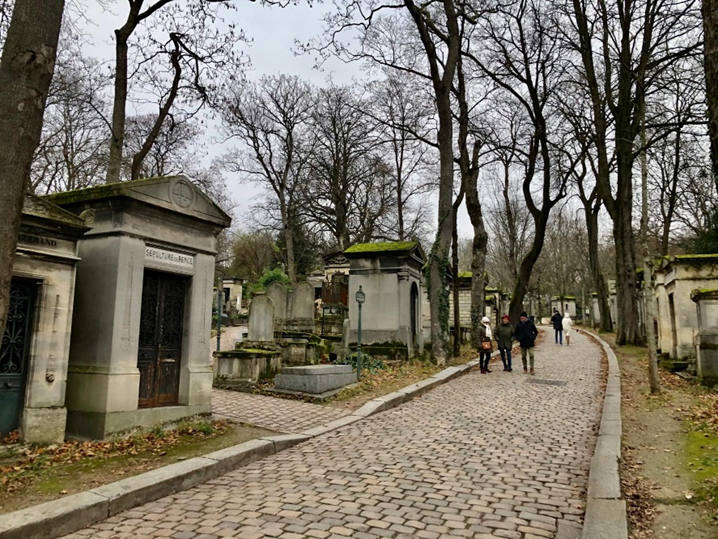
« For the past four years, we have been promoting this extremely lively arrondissement. We’ve been emphasising the village feel and the ecological and natural aspect, as we have the Bois de Charonne, the Père-Lachaise cemetery and other green areas. »
The cemetery, the world’s most visited, is a major asset for the district. According to the politician, it welcomes 3.8 million visitors a year. « We organise themed tours with historians, in several languages. »
« Not all flashy and polished »
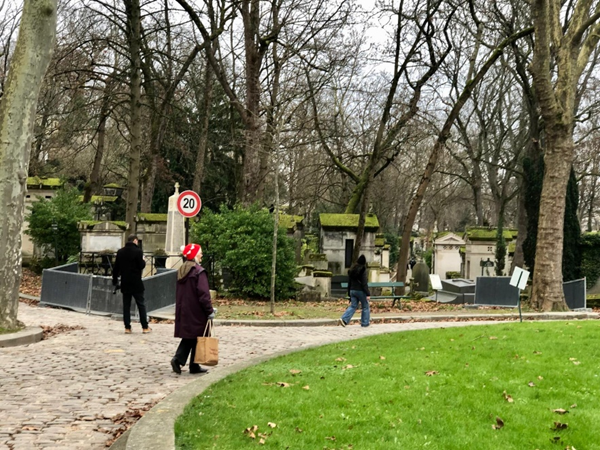
There are indeed a few foreign tourists in the Père-Lachaise on Thursday morning. Treasa, a retired Irishwoman, is wandering alone, shopping bag in hand. She is visiting Paris for the second time. « On my first stay, I did what you might think of as the ordinary things. » She now enjoys not having an agenda. « I’m very open-minded: even walking up and down the Seine is great ».
Nearby, Grady is walking with his son Clive. The pair are from Melbourne, Australia, and looking for Oscar Wilde’s grave. This is Clive’s first visit. He already went to the Catacombs and the ‘Petite ceinture’, a trail along an old railway line. « I like things that are more authentic and less popular. I want to see everything, both the good and the bad. I enjoys areas that are not all flashy and polished ».
« Working-class neighbourhoods have a heritage and a history too«
In cooperation with the Tourist Office, the City Hall of the 20th arrondissement is developing a promotional campaign « to highlight the material heritage, history and cultural diversity of the district ». For instance, it has restored the Pavillon de l’Hermitage and turned it into a museum. It has also created an interactive map for visitors. « We’re mainly highlighting what we call small-scale heritage: a particular house or street sign. »
The promotion of neighbourhoods like Belleville, still in the 20th arrondissement, also relies on initiatives by local residents. Théo Abramowicz has been a tour guide for 9 years. « Initially, I ran tours in popular districts such as Montmartre and the ‘Quartier latin’. Then I moved on to the 13th arrondissement, known for its street art, as well as Belleville and La Goutte d’Or. » His tours, in French or English, are mostly enjoyed by French people, but also by foreigners who want to go where no-one else goes.
Théo Abramowicz is trained as a historian and includes the popular and social memory of the area in his tours. « I want to show that working-class neighbourhoods have a heritage and a history too. » He seeks to put his visitors at the heart of the lives of the residents, not merely the architectural heritage. « I have found that people are proud to see that we’re visiting their neighbourhood. »
The risk of gentrification
These new visitors do, however, create a risk in areas undergoing tourist development: that of gentrification, which Claire Goffaux-Espejo finds very worrying. « Belleville, for example, is gentrifying at high speed. » The local council is therefore trying to put the brakes on AirBNB and promote businesses that are financially accessible to local residents.
How, then, can tourist attractiveness be combined with measures to prevent gentrification ? « By offering activities first and foremost to local residents, and if tourists are interested too, then all the better. » For instance, the Pavillon de l’Hermitage will be a museum of pictorial art, but will also include a cafeteria and a play area for the local children. « We’re making the neighbourhoods more pleasant for everyone who frequents them, without disfiguring them. »
Nina Waechter